
Actually, it’s a strange topic for a holiday destination, but I’ve always been fascinated by cemeteries of different cultures, including the various cemeteries on Kos.
Even in European countries, funerals and burial places differ:
Funerals are very emotional in Greece; for me, they are beyond tragic and difficult to bear:
(well, not all funerals are pretty, of course..)
Greek funeral
It begins with the burial of the deceased at home, so that all family members and friends have enough time to say their farewells. Another tradition is the „mourners,“ who throughout the entire time with the grieving family express the loss through weeping and lamenting. On the day of the funeral, the family then walks the coffin to the church, the front door remains open so that the spirit and soul find their way outside.
The funeral ceremony in the church also takes place with the coffin open. At the cemetery, the coffin is then opened for the last time, the face turned to the east (towards Eden) and covered with a cloth bearing the image of Jesus Christ or a cross. The coffin is sprinkled with oil and earth by the priest in the grave, and blessed.
The Graves
The graves in Greece consist of marble slabs, sometimes with a glass box in which candles, photos and mementos of the dead can be seen. However, fresh flowers are almost never found; occasionally there are plastic flowers or a wreath, but that does not mean that the relatives do not visit the grave site. Regular visits to the graves are just as common here as in Germany.
Another major difference is that after a few years the bones are dug up and washed again. If the bones are white after washing, the deceased is in heaven; if they are black, he or she is roasting in hell – at least that is the old belief.
Afterwards, the bones are buried in a sack in the family grave or stored in small buildings on the cemetery in caskets. On some cemeteries, these boxes are neatly stacked and closed. But I have also known cemeteries where the boxes are damaged and the bones are carelessly scattered in the hut. Quite scary, I know.

Greek Orthodox cemeteries can actually be found in every town here.
There are rarely any cremation services in Greece because they are not in keeping with the Greek Orthodox religion. There is only one crematorium in Athens.
But there are also cemeteries on Kos of other cultures:
Jewish, Muslim and Catholic:
[googlemaps https://www.google.com/maps/d/embed?mid=1OIPuW5rjtHiC79jeS2mwsAyQkw0&w=640&h=480]
Along the road between Kos Town and Platani there is still a Jewish cemetery. Only the David stars on the closed entrance gates still remind us of it. Unfortunately, you are not allowed to visit the cemetery.

Right next to it is the Muslim cemetery, the final resting place for the Muslims of Kos Town. Here, the deceased are buried according to the Muslim faith: only wrapped in shrouds and without a coffin. It is said that the deceased of the last 500 years are buried here. However, most of the inscriptions on the gravestones are in Arabic script and are therefore unfortunately not readable to me. The access is paved with gravestones on both sides. What is striking here is that the graves all look very different; some are planted, others covered with pebbles or earth. Some, like in the Greek Orthodox faith, are made of marble slabs.
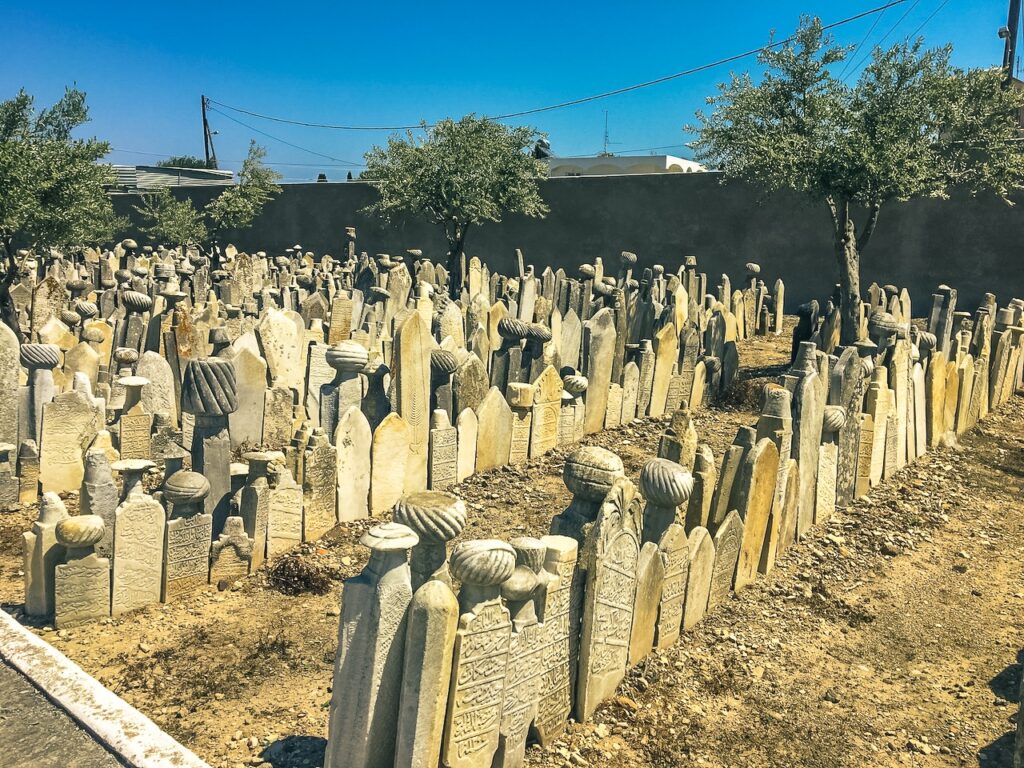
There is another Muslim cemetery in the town of Platani. This is again only intended for the residents of Platani.
Originally there were three Catholic churches on Kos, but only the Agnus Dei The church still exists (located between the ancient Odeon and the Casa Romana). The path to it leads through an impressive cypress avenue. The church was built in 1920 but was destroyed in 1933 by a major earthquake and rebuilt by the Italians. Included is a small cemetery as well as a memorial plaque commemorating all the Italian officers murdered by the Nazis in 1943.
In case anyone is interested in church services:
Catholic services usually take place every Saturday at 18:00 and on Sundays at 11:00 and 18:00.
The Greek service is always on Sundays at 10:00 a.m. and on many other „holy“ days.
More about Kos and life on the island in my travel guide*
*Affiliate Link
The Greek Orthodox Baptism
Easter in Kos
Work on Kos