
The Greek Orthodox baptism has little to do with our baptism.
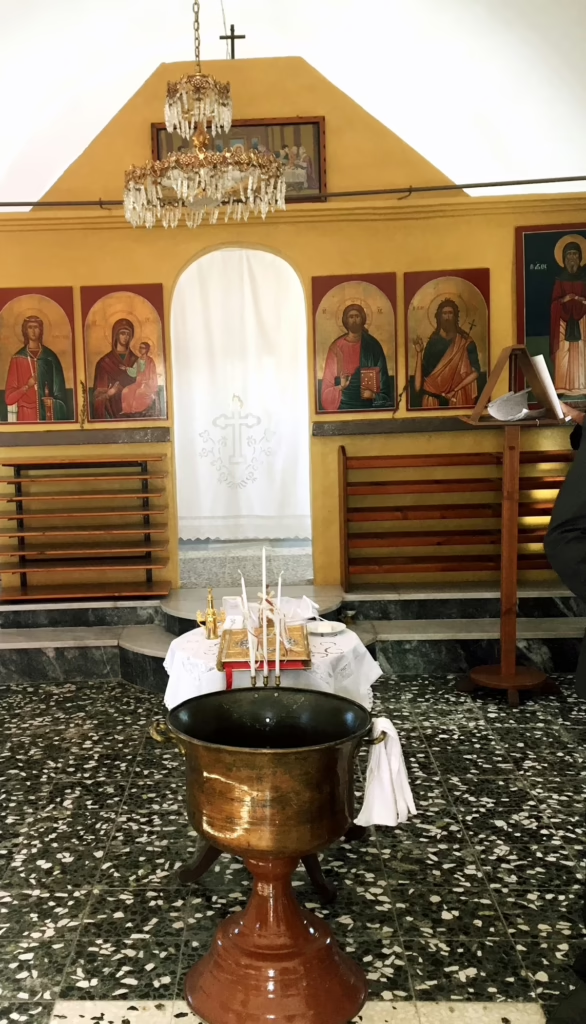
Here is an example of the celebration:
One needs in advance for the Greek Orthodox baptism:
- 1 child
- 1 Greek mother-in-law who insists on a Greek Orthodox baptism.
Babies without names
In Greece, children do not get their names at birth, but only after baptism. Until then, they are not addressed by their names, but only by nicknames like “favorite,” “baby,” or similar. That’s why my children were baptized when they were very young. 😉
Very time-consuming, since in Germany you already decide on the child's name at birth.
Here I know children who were called by nicknames exclusively during their first years of life, and I was always somewhat annoyed when the parents of their already speaking and active children told me that they still didn’t know how they would call their child.
Traditional naming is done either after grandparents or after deceased family members. That is why there are so many identical names in Greece. If you don’t want to follow the tradition, you at least need a Greek patron saint.
My daughter Melina is named Melina Sofie, baptised Sophia, and Emily Zoe was baptised Emilia.
Ingredients for the Greek Orthodox baptism:
- 1 Church
- 1 priest
- Decorations for the church
- a gold chain with a cross for the newborn
- Baptismal oil
- Baptism candle
- a completely new outfit for the baby after the christening, including underwear, towel, headwear and shoes
- 1 box where the outfit is stored and the other necessary utensils are kept.

Not all priests baptize children of unmarried couples, or even if neither of the parents is baptized in the Greek Orthodox faith.
All costs related to the christening are covered by the godparents. Since baptism in Greece is almost as important as a wedding, there are of course special shops for all the necessary purchases, where it quickly becomes dizzyingly expensive to buy a simple christening candle. Prices for the outfits can be expected to cause high blood pressure or even fainting.
Due to the enormous costs, the original purpose of a sponsorship is unfortunately lost. Friends or relatives would be happy to take on the sponsorship, but they cannot afford the costs of the baptism and therefore refuse the sponsorship. In recent years, things have relaxed somewhat, and baptisms can now be celebrated more cheaply, but in the end it is up to the Greek mother-in-law, who usually wants to celebrate in a traditional and lavish way 😉
During the baptism, the following performers are present:
- a screaming baby
- a completely distraught mother of the newborn
- The father of the newborn, recognizable by a proud chest.
- Overwhelmed and excited godparents
- Very proud and hectic mother-in-law
- Statists – many people whom you don’t even know at all.
Before the ceremony, the child is handed over to his/her godparents and the mother only receives him/her back after the ceremony.
This consists of a lot of incense, chanting, prayers from the sponsors, and the priest's sermon. The duration is also quite different here; for my children it took what felt like days, while for my friend's baptism it took about half an hour.
The child is completely immersed in the diving pool three times, but even there some priests have now come to feel sorry for the little creatures and only cover the little head with holy water. The protest of the parents is limited to whining, but at the third immersion at the latest it turns into loud screaming. The mothers’ eyes turn red alternately to the mother-in-law, the priest and the father of the child to be baptized. Greek mothers are reportedly somewhat more relaxed in this situation, but here in Northern Europe religion usually does not have such a high status, and therefore we are very sensitive to this aspect. After that, the slippery, oily and roaring thing is put back into its new outfit and then handed over to the (more relaxed) mother again.
The guests all receive a bonbonniere, bags with wedding candies, sometimes a small gift such as a pendant or something similar is attached to them. The candies are used as a symbol of life with all its ups and downs, the sweet glaze stands for the wish that life will be more filled with happiness and joy. The costs for the candy and the meal with family and friends (usually in a tavern) following the baptism are covered by the parents of the newly baptized.
After the baptism:
- a mostly exhausted baby
- completely relaxed parents and godparents
- Very, very proud mother-in-law
- Friends and family who are celebrating exuberantly.
According to the beliefs, the oil-covered baby must not be bathed for three days after baptism; only then is the child to be washed by the godparents in the sea. My mother-in-law took over the bathing at that time and then poured the bath water into the sea and burned the diaper.
Greek Orthodox baptism also requires that the sponsor or sponsors should go to church three Sundays in a row with the baptizing child for blessing. Of course, the new gold cross chain must be worn with the new bib.
But then you finally got through the procedure.
Looking back, it’s not so bad anymore and every child has survived the Greek Orthodox baptism without trauma in their later life, but you can celebrate holidays more relaxed.
You can find out more about Greek traditions and life on Kos in my Travel guide*
The Greek Easter Festival
The Greek Fasting Season
Christmas and New Year's Eve in Kos
Work on Kos
The Greek school system
Medical care on Kos