
The Greek school system was the reason my older daughter went to Germany at the age of 16 to complete her high school diploma, which she also passed with distinction two years later in 2019.
It wasn't easy as a mom when the older one left home so early, but then and now I know that it was the right decision.
Melina has harbored the desire to go to school in Germany and get an A-level qualification there for years. I can very well understand her decision, because the school system here is very dilapidated and outdated:
The Greek school system is described quickly – Not contemporary
In Greece, primary school lasts for 6 years, then there are 3 years of high school, which corresponds to our comprehensive school, then 3 years of Lykeio, which then concludes with the matriculation exam. There are no different types of schools here, and therefore no different school diplomas either.
Even at the time of enrollment, the seriousness of life begins:
The entire class is being taught here; Melina was born in December and was enrolled at the age of 5 as the youngest in her class.
There are no "can't-have-children" – although it is possible to educate the child later on, you cannot then continue sending them to kindergarten or preschool.
Leaving the child at home for a year felt absurd to us – and not feasible even in the summer, since we both work full-time. Unfortunately, my mother-in-law had already passed away at that time; until her death in the summer, she had always been very supportive in taking care of the baby. So Melina was enrolled in school at the age of 5.
The enrollment process here proceeds quite unpretentiously:
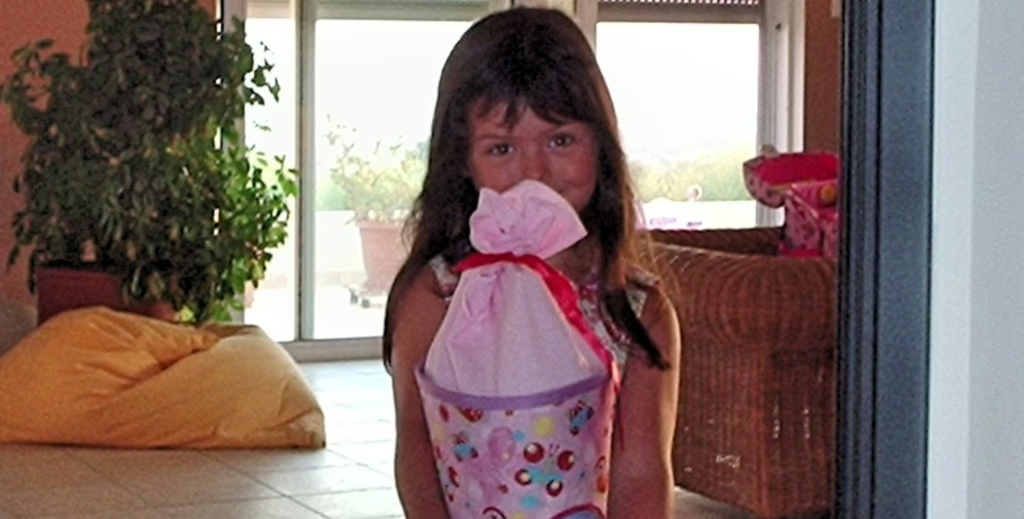
The children were greeted by the director in a short and concise manner, then they were assigned to their classes by name and the enrollment was complete. There are no school bags here, but Melina received a classic school bag from us, specially flown in from Germany and yes, she was very proud.
My mood reached a boiling point when I visited the toilets on the first day of school and found dirty and smelly cubicles.
My horror lasted for months and almost kept me up at night. Often we would drive home after school, with the car screeching and the tires squeaking, because Melina and later also Emily simply refused to use the school toilets and it was therefore quite urgent sometimes.
Today we all laugh about it, but back then we didn't find it so funny.
Schedule? None available
In the first few years of school, we didn’t even know what a timetable looked like:
The children were given masses of books in their first years of school, which were also brought in daily and the teachers were instructed on what was currently on their minds. Of course, there was no possibility of storing the heavy books in the school either.
From the very beginning, proper learning takes place here; there is no teaching of material through play.
There was no sports hall – occasionally ball games on the courtyard – but often not – according to the teachers’ opinion, it was either too warm, too cold or even too windy. My children grew up without athletics, floorball or gymnastic (that would have been a dream for me 😉)
Even in elementary school, the children only get A-grades no matter what their achievements are; talents or learning disabilities are therefore often long ignored. I didn’t find it strange at the time when my daughter told me that the teacher called her husband during class and asked him to bring the laundry in because it was raining. Of course, I am aware that there are bad teachers in Germany as well, and the school system there has its weaknesses; however, it has rarely been of any use to me in my dark moments.
Supporting teaching materials such as photocopies were mostly copied during the lesson, and the children were then left in the classroom alone, which often ended in chaos and thus naturally also lost valuable teaching time.
Parental evenings were also generally held during school hours; the children were free during this time and played in the schoolyard. The lack of teachers or long sick leaves for teachers and strikes often meant that the kids were under a lot of pressure and had to cram the material into their heads very quickly. Exams are taken at the high school level, at the age of 11 or 12, at the end of each school year. Students are released from school for weeks to study independently for the exams – so it can only go wrong.
My younger daughter and her friend founded a study group for the exam in their second year of high school – please don't ask any more questions 😉
Then – Today
Since 2017, at least in high school, not all subjects are no longer tested; only the core subjects are. A small improvement, albeit insignificant in the broken down school system.
Oh, another thing that gave me a quick pulse was the school trips: you spend the whole day at either the parking lot of the Asklepion or you go to the playground in Mastichari or Antimachia. The teachers are drinking coffee, the kids are sitting in a corner. A playground has lost its appeal more or less since the second grade, so you can see that the Greek school system isn’t necessarily a topic that makes me happy.
The salary of teachers – the key criterion for the Greek school system
There is little to criticize the teachers:
In the Greek school system, the starting salary is One teacher’s salary is approximately €800. For generations, there has been the „Frontistirio“ in Greece. Private tutoring or group lessons in a private school in the afternoon. It starts in the elementary school with English. Although it is taught in the school from the 3rd grade, it is only sporadic. Almost all children start taking private English lessons in the afternoon from the 1st grade. The teachers know this and therefore teach at a very low level. The 2nd foreign language (German or French) is taught from the 5th grade, but there are usually no teachers available.
My girls both chose French, but due to a lack of teachers, this is hardly taught. They did get a grade at the end of the school year, but they had hardly any or no foreign language classes at all. And of course, they also had little knowledge of the second language. At least in the Lykeio, additional tutoring in other subjects is added later on.
Private lessons
95 % of the students have taken additional private lessons several afternoons a week. It’s a vicious cycle: the teachers teach little in school in order to earn extra money in the private lessons in the afternoons. However, families can increasingly not afford this additional tuition. As a result, more and more students leave school without a proper high school diploma. In the final year of high school, additional costs of an average of €500–600 per month for tutoring are added to the parents’ expenses. Otherwise, the kids have hardly any chance of passing the Greek high school exam. High praise for the Greek school system!
Vocational training? Absolutely not
There is no classical vocational training in Greece; everything is studied. In Kos, almost all the locals work in tourism, which of course severely restricts career choices. I think the foundation for a well-rounded education or even a degree is more common in Germany. I also feel more comfortable with the decision to have it in Germany near my parents. Kos has no universities, so they would have to go to the Greek mainland, Crete, or Rhodes to study. Therefore, Germany was definitely the right choice. I am very glad that my children have survived the Greek school system despite all the obstacles and have found their way into the professional or student life.
The Greek school system is overwhelming and persistent in my life as a foreigner.
Another very defining experience is the Baptisms in Greece.
There is more about the mentality of the Greeks here to read.
Work on Kos is also an experience in itself 😉
You can find out more about life on Kos in my travel guide*
*Affiliate link